
What Tile Size Actually Does to a Room, and How to Choose the Right One
Tile size isn't just a practical spec. It's a design decision that changes how a room looks, how big it feels, and how much maintenance it takes to keep clean. Here's what's actually happening when you go bigger, or smaller, and how to think about it for your specific space.
Bigger Tile Makes Rooms Feel Larger
This is the one most people have heard, and it's true, with some nuance.
Large-format tile (think 24×48, 24×24, or even 12×24) creates fewer grout lines across a surface. Fewer grout lines means less visual interruption. Fewer interruptions mean the eye reads the floor or wall as one continuous surface rather than a grid of individual pieces. The room feels more open, more expansive, more cohesive.
This is especially effective in open floor plans, which are common in Southwest Florida homes, where tile runs through multiple connected spaces without a break. One continuous surface across a kitchen, dining area, and living room reads as significantly larger than the same space tiled in smaller format with more grout lines cutting through it.
The caveat: Large tile needs a flat, well-prepared substrate. The bigger the tile, the less forgiving it is of dips or humps in the floor underneath. This is a conversation to have with your contractor before you fall in love with a 24×48.
Smaller Tile Adds Visual Texture and Detail
Smaller formats such as mosaics, 4×4, and classic 3×6 subway, do the opposite. They add visual texture, pattern, and detail to a surface. More grout lines mean more rhythm, more movement, more character.
This isn't a weakness. It's a tool.
A pebble mosaic shower floor. A penny tile backsplash. A basketweave pattern in a powder room. These work precisely because of the tile-to-grout ratio. The smaller the tile, the more the pattern takes over, and in the right space, that's exactly the point.
Small-format tile is also the practical choice for shower floors, where the pitch toward the drain requires more flexibility than a large tile can provide. More grout lines also mean better traction. Function and design working together.
Tile Shape Changes the Perceived Direction of a Space
Size isn't the only variable. Shape matters too, and it's one of the most underused design tools in a renovation.
Horizontal layouts make walls and floors feel wider. A subway tile laid in a standard horizontal brick pattern stretches the eye sideways, useful in narrow bathrooms or galley kitchens.
Vertical layouts pull the eye upward, making ceilings feel taller. The same subway tile stacked vertically in a shower can make a standard 8-foot ceiling feel significantly more generous.
Diagonal layouts add energy and movement. They also visually expand a space because the diagonal line is longer than the horizontal or vertical, so the eye travels farther across the same square footage.
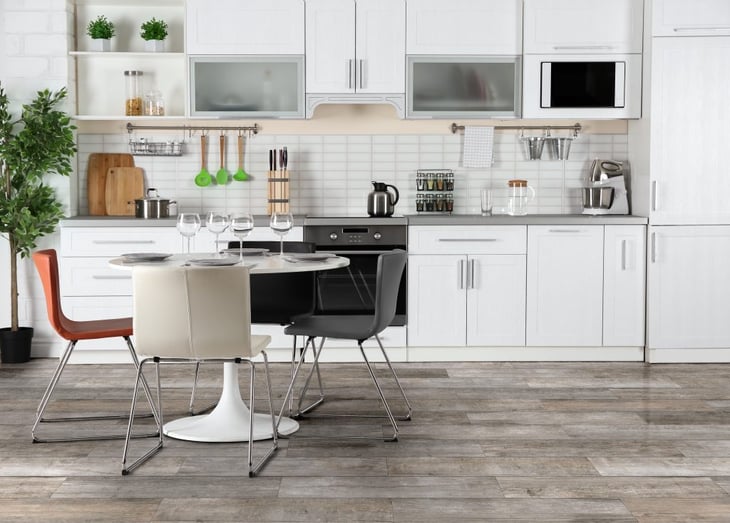
Large plank formats (like wood-look tile in a 9×48 or 8×47) laid lengthwise along a room make that room feel longer. Laid perpendicular to the longest wall, they make the room feel wider. Same tile, completely different spatial effect.
Grout Line Width Is Part of the Equation
Tile size directly affects your grout joint, and your grout joint is part of the finished look whether you think about it or not.
Large rectified tile can go down to near-invisible grout lines (1/16 inch), creating that seamless stone-slab effect. Standard tile typically calls for 1/8 inch or more. Mosaic tile often has 1/16 inch joints built into the mesh backing.
A wider grout line emphasizes the grid pattern and makes individual tiles more visible. A thinner grout line lets the tile surface dominate. Neither is wrong; they just produce different results.
One practical note: wider grout lines are easier to maintain in some ways (more flexible, less likely to crack) and harder in others (more surface area to keep clean). Narrow grout lines look sleeker but require a flatter substrate and more precise setting.
How to Think About This for Your Home
A few questions worth considering before you commit to a tile size:
How does this space connect to adjacent rooms? If your new floor tile will meet existing tile or flooring in a visible transition, the scale relationship between the two matters. A dramatic size jump can look jarring. A complementary size (not matching, but harmonious) looks intentional.
How much natural light does the room get? Larger, lighter-toned tiles amplify light and openness. Smaller, busier patterns in a dark room can feel heavy. Florida homes with good natural light can handle more dramatic choices, but it's worth seeing a sample in your actual space before deciding.
What's the square footage? Very large tile in a very small room can feel overwhelming — like furniture that's too big for the space. As a general rule, your tile shouldn't be larger than roughly one-third of the room's shortest dimension. A 24×24 tile in a 5×8 bathroom works. A 24×48 in the same space is a tighter call.
What's the maintenance reality? Large tile means fewer grout lines to clean. If that's a priority, and in a busy Florida household it often is, a bigger format is worth factoring in for that reason alone.
The Right Size Is the One That Works for Your Space
There's no universal answer. A sprawling open-plan living area and a compact guest bathroom have completely different needs, even if the same homeowner is choosing tile for both.
What we do know: tile size is one of the highest-impact, lowest-cost design decisions you can make. Choosing a slightly larger format costs a little more per square foot in some cases, but it changes the entire feel of a room.
Come in with your room dimensions, some photos, and whatever inspiration you've collected. We'll pull samples at a few different scales and show you exactly what the difference looks like side by side.